

Ophia's Sister-Soul (Parting the Veils, Book 1) is a metaphysical epic that weaves together the fates of twin souls across two interconnected worlds—Earth and Ophia—both of which suffer from a rupture in their connection to the primal creative force, Sorsajna. The narrative is framed as a mythic recounting by Sanyori Mon-Sequestra, a Wakeful Dreamer and former dramatist who now exists as a sentient presence within the ethereal Sentient Library. Sanyori presents the story as a drama orchestrated by a council of souls in a pre-incarnational dream-moot, where the protagonists agree to undertake lives of suffering and amnesia to heal the schism between worlds.
The story opens with Colleen Addison, a young woman on Earth, writing a journal entry to her deceased twin sister, Stacie. Colleen is institutionalized after a suicide attempt on their shared birthday, an act rooted in her survivor's guilt from witnessing Stacie's fatal fall from a tree they once imagined as a magical bridge to another world.
Colleen's narrative establishes her as a "Glorious Misfit," alienated by trauma and clinging to the metaphysical teachings of her childhood therapist, Saul, who taught her that reality is a story shaped by the soul. Despite her pain, Colleen's love for Stacie remains her only bridge to meaning, foreshadowing her role as a soul-bridge between worlds.
In tandem, the narrative shifts to Ophia, a world dominated by the Cordonne, a technocratic regime that enforces control through the Weaving, a surveillance network that manipulates emotions and behavior. Esperidi Mon-Sequana, Colleen's twin soul, lives under the oppressive rule of her father, Pallides, a City Father of the Cordonne.
Esperidi is a natural Sophryne who practices the forbidden art of Wakeful Dreaming. She becomes the apprentice of Shiya-coqui, the last master of the Sophryne order, after overhearing a confrontation in which Shiya-coqui warns Pallides that misusing Sacred Timbre—the manipulation of reality's energetic vibrations—will cause a cataclysm known as the Rupture. Dismissing the warning, Pallides proceeds with his plans.
Esperidi flees with Shiya-coqui to the Sophryne refuge beneath Mount Veneer, learning that the Cordonne's corruption of Sacred Timbre has severed Ophia's connection to Sorsajna. Their escape is marked by a supernatural fog conjured by Shiya-coqui, which triggers in Esperidi a prophetic dream of Ophia's destruction. This vision materializes when the Cordonne uses Sacred Timbre to destroy the invading Chonnen army, causing the Rupture—a sequence of environmental disasters that devastate Ophia's civilization. Anticipating her own death, Shiya-coqui sends Esperidi into exile, sealing her in a desert refuge with supplies and a map to the Savwain Desert. Esperidi is left isolated, bearing the weight of her world's loss.
On Earth, Colleen psychically experiences the trauma of Ophia's fall, deepening her connection to Esperidi. Sanyori, acting through Colleen's gift of automatic writing, channels the story of Esperidi's exile, further entwining the twin souls' destinies.
The narrative broadens to include Kanchi, a mute Oskwai girl in the Sendhi steppes. Guided by Sophryne lights, Kanchi discovers Sanyori's scrolls in the abandoned Hive of Kublai, learns the Sophryne ways, and regains her voice. After a vision of her tribe's destruction, she leads a portion of her people to safety in the Hive, survives another cataclysm, and emerges as their spiritual leader.
After two years in exile, Esperidi journeys to Magda's Oasis, a haven for outcasts. There she meets Ashangtu Lanore, a Shaini survivor embittered by loss. The Oasis is threatened by bandits from New Shetain, a militaristic society descended from a fanatical Hive. Ashangtu uses her latent Sacred Timbre abilities to negotiate with the bandits, while Esperidi, prompted by a prophetic dream, joins Ashangtu and the Manitoh trader Tohbin on a trade mission. When a rattlesnake bites Tohbin, Esperidi enters a trance, crosses the Partition, and calls his spirit back, saving his life by invoking his love for his son. Tohbin confesses his original intent to betray them but renounces it, cementing their alliance.
The climax unfolds at Jamurada, a sacred stone circle where Sanyori convenes a gathering of surviving Oskwai tribes. The meeting is fraught with tension and threatened by the arrival of Konatep, a Shetain high priest, his Inook assassins, and Ashangtu's estranged sister, Ildriss. Ashangtu flees, unable to face Ildriss. Konatep exposes Sanyori as a magical projection and attempts to execute Esperidi. In response, Esperidi channels the spirit of a deceased chieftainess, activating the stones of Jamurada with mystical energy. At this critical moment, Wakeen—Jain-Toh's estranged son—arrives with Sarpi, a giant serpent, and defeats Konatep and his forces. Wakeen departs, leaving Esperidi as the spiritual leader of the united tribes.
The novel concludes with Colleen's journal entry as she is released from the hospital, feeling both fearful and hopeful, ready to embrace her soul's path. Esperidi embraces her role as teacher, mentoring Suskhana, a gifted Oskwai woman who becomes a spiritual leader. Esperidi's final act of healing is a trance journey across the Partition to the afterlife, where she confronts her father's soul. She helps Pallides face his guilt and repressed desires, enabling his release and finding her own closure. As Pallides' soul is enveloped in light, Esperidi awakens with a sense of peace. Ophia's Sister-Soul thus completes its narrative arc by healing personal and cosmic wounds, setting the stage for future reconciliation between worlds.
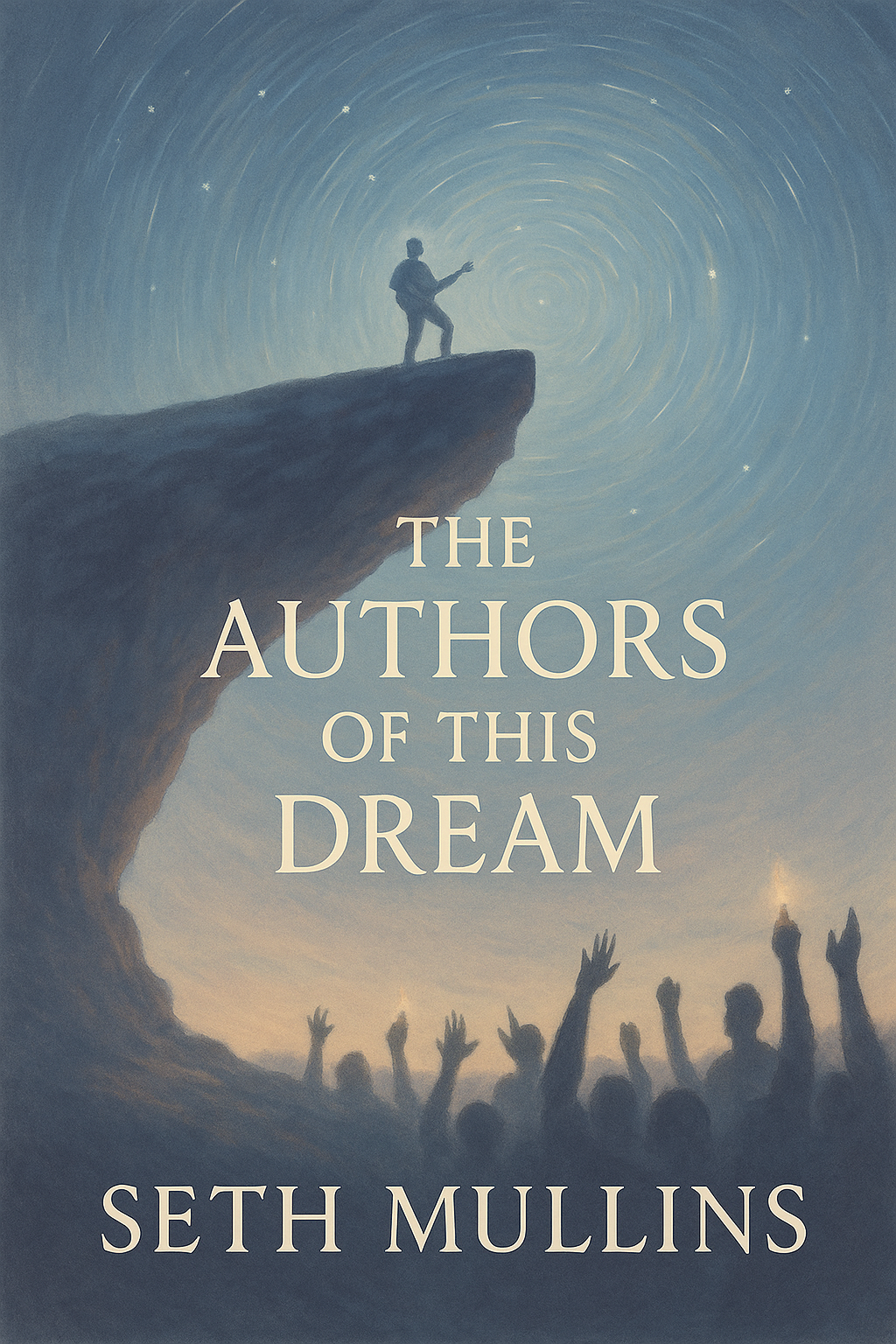
(⚜️ These outlines trace the dream’s full unfolding — from separation to remembrance. If you prefer to encounter the stories’ revelations as they unfold, you may wish to begin with the books themselves.)
The Authors of this Dream is a character-driven coming-of-age novel that follows Brandon Chane, a troubled young guitarist, as he forms a band and embarks on a journey of self-discovery, grappling with trauma, addiction, and the search for meaning through music and philosophy. The story is told in first-person from Brandon's perspective, offering an intimate account of his psychological and emotional evolution.
The novel opens with Brandon reflecting on his recurring proximity to self-destruction, which he calls the "Abyss." Music, particularly the cathartic energy of underground rock, is his only lifeline. Alongside his best friend, Tommy Visconti, Brandon vows to form a band in their hometown of Sadenport, Oregon. Brandon, marked by violent impulses and a history of family trauma—his mother's early death and his father Robert's alcoholism and abuse—finds solace in his guitar. Tommy, an intellectual steeped in philosophy and shamanic traditions, becomes both bassist and philosophical anchor, interpreting Brandon's volatile perceptions as gifts rather than pathology.
Tommy envisions their music as a vehicle for exploring the psyche's shadow, urging the band to channel suffering into creative ecstasy. During a pivotal rehearsal, Tommy challenges Brandon to write lyrics that reflect his real pain, particularly his anger over his dysfunctional family and his protective role toward his younger sister, Rachel. This confrontation unlocks Brandon's creative potential, resulting in his first authentic song.
The band, initially named Crave Oblivion, records a demo and books their first gig. On the eve of the performance, Brandon's anxiety and nihilism peak. Outside the venue, a minor altercation with a drunken man escalates into a near-fatal assault, with Brandon barely restrained by Tommy's intervention and a flash of memory involving Rachel.
The trauma of this incident leaves Brandon emotionally shattered. He is introduced to cocaine by Kelly, a girl at the venue, which temporarily strips away his numbness and forces him to confront his actions, leading to a breakdown.
Despite his turmoil, Brandon performs at the gig, where the band adopts the new name Edge of the Known, reflecting their shared ambition to push musical and existential boundaries. However, Brandon's personal life deteriorates further after a violent confrontation with his father leads to his arrest. A psychiatrist secures his release on the condition that he move out, separating him from Rachel and leaving him adrift. In the aftermath, Brandon undergoes a psychedelic experience, which provides him with a fleeting sense of unity and empathy, challenging his feelings of alienation.
Seeking refuge, Brandon turns to Saul Mason, a reclusive man who had previously offered the band rehearsal space. Saul becomes his mentor, introducing him to the philosophy that reality is a personal creation and that individuals are "the authors of this dream." Saul's teachings encourage Brandon to take responsibility for his own perceptions and experiences, rather than viewing himself as a victim of circumstance.
Saul also introduces Brandon and Tommy to Carlos Rodriguez, a talented drummer recovering from addiction. Carlos's arrival revitalizes the band, and Brandon's songwriting matures as he integrates Saul's philosophical insights and develops a romantic relationship with Janie, whom he meets after defending her at a gig. The band's sound evolves, embracing greater emotional depth and improvisation. Their progress culminates in their debut album, “What Casts the Shadow?”, a title that encapsulates Brandon's quest to understand his inner darkness.
Despite creative breakthroughs, Brandon's unresolved guilt and emotional volatility sabotage his relationship with Janie, who ultimately leaves him. The situation worsens when Brandon learns of his father's suicide attempt. Guided by a prophetic dream, Brandon intervenes and saves his father's life, initiating a tentative reconciliation. The band embarks on a tour of the East Coast. Still, Brandon's internal conflict reaches a breaking point after a transcendent performance in Vermont, where he destroys his guitar in a fit of despair, feeling that artistic achievement alone cannot heal his pain.
The tour collapses, and Brandon returns to Oregon at Saul's urging, expecting to attend the funeral of Saul's wife, June. Instead, he finds June alive and fully recovered from a terminal illness. June explains that she healed herself by confronting her deepest fears and consciously changing her beliefs, providing Brandon with tangible evidence of Saul's philosophy. This revelation marks a turning point for Brandon, who finally accepts his own agency in shaping his reality.
The novel concludes with a series of resolutions: Robert Chane agrees to seek therapy with Saul, Janie reaches out to reconcile, and the band secures a replacement guitar and a renewed opportunity for their New York showcase. In the final scene, Brandon tells Rachel a bedtime story about a girl who weaves the world from her dreams, symbolizing his acceptance of the idea that he is the author of his own life. The ending affirms Brandon's transformation from a self-destructive outsider to a self-aware creator, setting the stage for further exploration in subsequent volumes.
The Authors of this Dream employs a linear structure punctuated by intense emotional and philosophical turning points, balancing the external narrative of the band's formation and rise with the protagonist's internal journey. The pacing alternates between periods of introspective crisis and moments of creative breakthrough, culminating in a climax that resolves both personal and artistic arcs. The novel's themes—trauma, agency, the transformative power of art, and the nature of reality—are embodied in Brandon's arc, which is supported by a cast of characters who each serve as catalysts for his growth. The story's structure and character development provide a solid foundation for the series, with clear stakes, escalating conflict, and a satisfying resolution that leaves room for further evolution